
The History we made in this race
Results updated as of 11/17/2026 11:14:03 AM
The 2026 Maryland election for Governor and Lieutenant Governor included historic performances for two grassroots parties to the left of the Democratic Party.
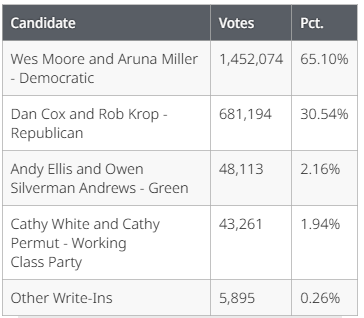
Third-Party Performance in 2026 Maryland Gubernatorial Election
Green Party
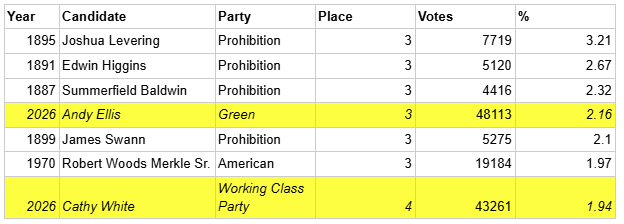
The Green Party ticket of Andy Ellis/Owen Silverman Andrews received 48,113 votes and had 2.16%. This is the largest number of votes ever for a third-party candidate for governor in Maryland, the highest percentage since 1895, and the fourth highest percentage overall in the multiparty history of Maryland.
For the first time in the Maryland Green Party’s history, this election secured ballot access for 2028 by passing the 1% vote threshold in a Gubernatorial election - See below for explanation of third-party ballot access qualification
Working Class Party
The Working Class Party ticket of Cathy White and Cathy Permut also performed well. They received 43,261 votes and 1.94% of the vote. This puts them second in the total number of votes for third-party gubernatorial campaigns, seventh in all-time percentage.
While the Working Class Party passed the 1% vote test, their ballot access for 2028 had already been secured by the petition signatures they submitted in 2025.
Historical performance of third-party candidates in Maryland gubernatorial race:
Definitions & Caveats
Third-party candidates are defined as:
Nominated by a recognized political party, not independent or unaffiliated
Participating in an election with more than two candidates
Included on the official ballot, not a write-in
Performance of Independent/Unaffiliated Candidates
This definition excludes Hyman Pressman, who ran for Governor as an independent in 1966. Pressman was the sitting Comptroller of Baltimore City. He received 90,899 votes and 9.88% in the 1966 election.
He has the historic mark for votes and percentage of the vote for a candidate outside of the two-party system, but he was not nominated by a party. He was an independent/unaffiliated candidate.
Pressman’s story is valuable and important Maryland history, but it is not a third-party campaign. Maryland election law treats unaffiliated candidates that qualify by petition differently than they treat candidates nominated by non-principal political parties, and for the sake of our historical claim so do we.
Performance of the Union Party
In 1861 and 1864, the Union Party candidates defeated the Democratic party candidates in the gubernatorial election. In 1861 Augustus Bradford (U) won the race for Governor with 57,472 votes and with 68.81% of the vote. In 1864 Thomas Swann (U) had 40,579 votes and 55.86%.
The Union Party could be considered a third party in some ways; it was not the Republican Party and it was not the Democratic Party. In several states, the Union Party was a coalition that came together after the multiparty period of the 1850’s and in some states it stood in for the Republican party where the Republican label was untenable.
However, the Union Party was one of only two parties on the ballot and it was not a minor party; it won the governor's office and a majority in the General Assembly. In today’s terms, they would be defined as the majority party, which inherently makes them a part of the two-party system.
Like Pressman, they are an interesting part of Maryland’s political history, but they are not a third party for the purpose of our historical claim.
Ballot Access Rules
A new party qualifies for the ballot in Maryland by submitting a petition with 10,000 valid signatures from registered Maryland voters. When the party submits that petition, they become a recognized non-principal party in Maryland. This means that voters can affiliate with the party and candidates can seek the party’s nomination and appear on the ballot once they receive it.
Each successful petition qualifies the party for two general election cycles.
In order to retain ballot status, a party must receive 1% of the vote in either the Presidential or Gubernatorial races - whichever is the highest office on the ballot for that election cycle. Reaching this threshold secures ballot access for the next general election.
If a party does not receive at least 1% of the vote share, it can still maintain ballot access if 1% of all statewide registered voters are affiliated with the party. However, since this law was enacted, no party has maintained ballot access through this registration pathway.
When a party loses its ballot access, it must complete the petition process as a new party in order to regain its status.
Status of Third-Party Ballot Access in Maryland
The Green Party successfully submitted a petition in 2024 that secured ballot access for the party in the 2024 and 2026 general elections. Then, because they received >1% of the vote in the 2026 Gubernatorial election, they secured ballot access for the party in the 2028 election. If the Green Party receives more than 1% of the vote in the 2028 Presidential election, they will secure ballot access for the 2030 election.
The Working Class Party successfully submitted a petition in 2025, securing ballot access for the 2026 and 2028 general election. While the Working Class Party exceeded the 1% threshold in the 2026 Governor’s race, it was not required for them to retain ballot access in 2028; they had that as a function of their petition. If they secure 1% of the vote in the 2028 presidential election, they will retain ballot access for the 2030 cycle.